Creator: InspireStock
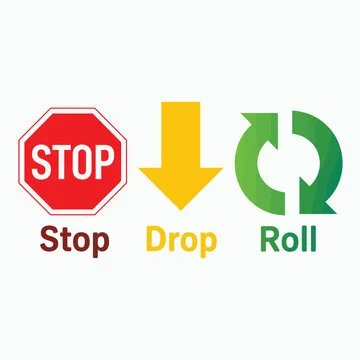
Stop, drop and roll – the old adage to help survive fire accidents. In other words, it is the thing the firefighter volunteers (or maybe in your case Smokey Bear) taught many of us as children if we ever caught on fire. Now, in this psychotherapeutic twist, we are going to learn how to survive metaphorical fires for our psyches.
This blog post is inspired by Resmaa Menakem’s idea published in his 2021 book: My Grandmother’s Hands: Racialized Trauma and the Pathway to Mending Our Hearts and Bodies. Let not the brevity of this post trick you into thinking that the book does not hold many, many more gems. This is just one of many tools from the book that I started implementing in my practice immediately, and I am sharing here, since it is simple enough, and accessible enough and, hopefully, needed.
Psychological “fire”
Let’s start with the definition of a metaphorical fire. Much like an actual fire, this would be an incident that is distracting – a painful, threatening, and invasive distraction. Think of the dread you feel before entering the office if your boss or colleagues are a source of threat to you, or when you hear your partner get frustrated in the other room and you know their anger may involve you as well, or when you notice yet one more politician acting selfishly and moving to harm communities. These are all examples of mental fires: painful, threatening, invasive, and distracting. Here’s the key word: distraction.
When metaphorical fires present themselves, we will instinctually ONLY focus on the fire, getting distracted from ourselves. And unlike actual fires, these fires sometimes are unextinguishable. Stop, drop, and roll will give us a tool to tend to ourself in those moments. Let’s see how it works.
Stop… focusing on the “fire”
“Stop” asks that you distract yourself from the “fire.” Notice when your calm is being disturbed by any “fire,” and try not to engage with it–the ultimate goal being to take care of you first.
“Fires” can be big or small. The most important thing is to notice when you’re on fire. As a small fire example, imagine an annoying person you have to be around for several days. If you were to focus on every single annoying behaviour, soon you’d be worn out, probably get into many small or big arguments, and even fight or rupture your relationship. “Stop” can be a useful technique here to signal a change in your engagement cycle with this “fire.” Let’s see what’s next.
Drop… into your body
Right after you recognize you are on fire and stop running around (with the fire), drop into your own body. Starting with the body is a great technique because it’s not something we often do, so it is novel enough to help stay distracted from the fire. Do a body scan: What sensation am I feeling? Where in my body am I feeling the sensation? And to deepen your connection to self, what does this sensation mean to me? Is the sensation connected to a feeling/emotion?
Use the wheel of sensations or wheel of emotions if you are new to this type of body/emotion scan.
Roll… with it
Lastly, when you get a hold of your emotions and sensations, keep rolling with what your body and your heart keep telling you. At this point, your brain may come to help with the process, or it may jump in to re-focus you on the fire again. Be careful here! If your brain is helping you to focus on yourself, let it; otherwise, you will need to remind your head that “I WILL focus on [the fire] soon, but right now, I need to help steady myself.”
Let your brain get onboard with the “stop, drop, and roll” and even help you. If your heart and body are telling you about a time from years ago when a similar fire deeply burned you, you will need your head’s help to come in and help you find tranquility.
“Stop, drop and roll” is a very short, effective, yet a difficult-at-first-technique to help you regain alignment in face of psychological threats and discomfort. Try it alone, or perhaps reach out to try it in a session. I look forward to hearing from those of you who gave it a shot.